
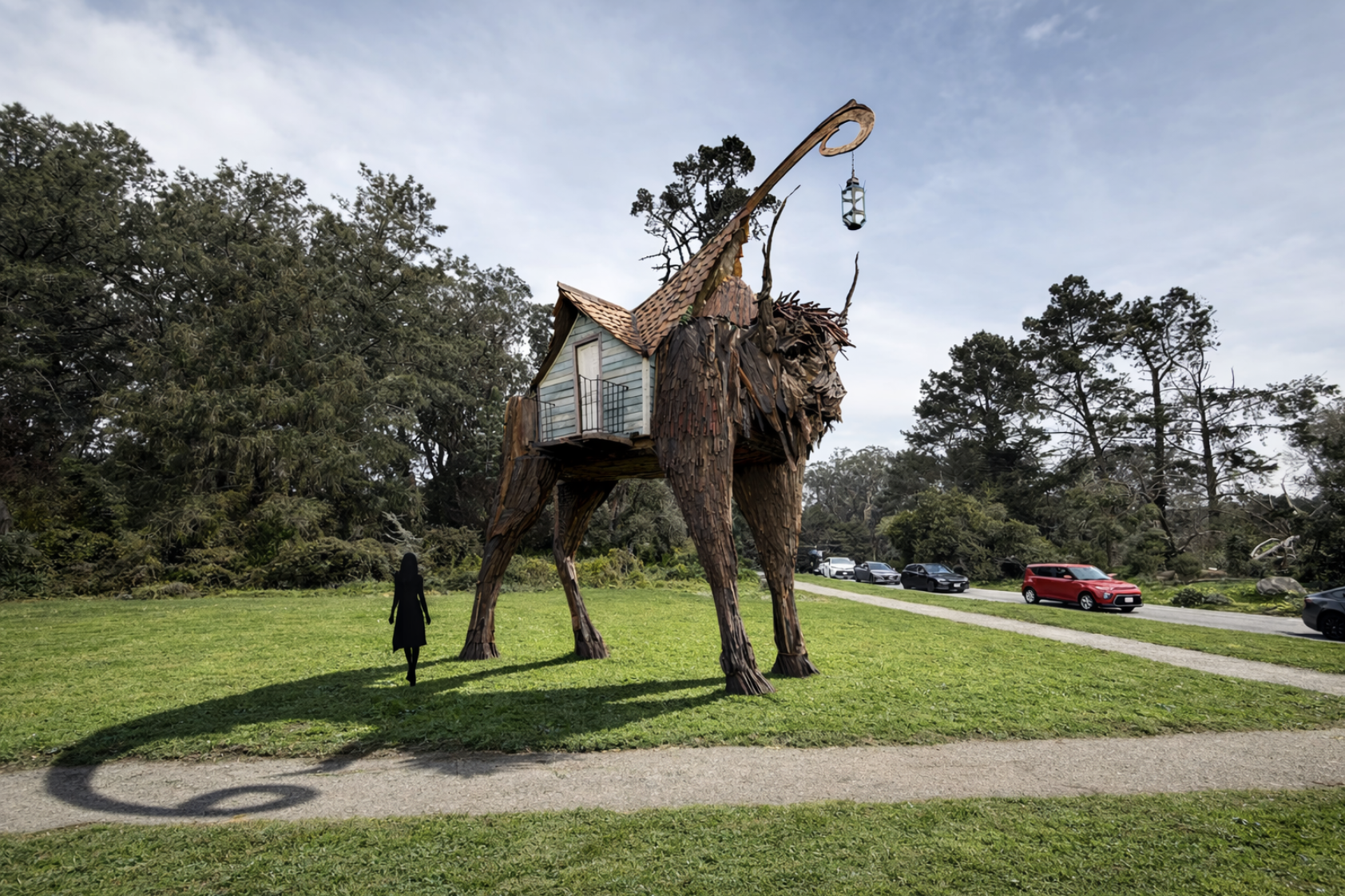
Burden of the Beast
-UPCOMING-
Big Art Loop is fiscally sponsored by Five Ton Crane. Please indicate that your gift is for Big Art Loop.
Burden of the Beast is a monumental North American Plains bison carrying the weight of a house through its body, constructed from materials salvaged from homes damaged by climate-related events. Placed within the Chain of Lakes in Golden Gate Park, the work sits in a landscape defined by water, migration, and ecological interdependence. The bison, once central to vast American ecosystems, appears here as both out of place and deeply symbolic, a reminder of displacement across time. The house embedded within its form evokes human presence and pressure on the land, suggesting shelter but also fragility. Composed of materials marked by climate impact, it carries the physical and emotional residue of environments under stress.
At the edge of these interconnected lakes, where water levels, wildlife, and weather patterns are in constant flux, Burden of the Beast reflects a shared condition of adaptation. It invites viewers to consider the weight of what we build, what we lose, and what we ask the natural world to carry alongside us.
About the Artist
Walker Babington is a New Orleans based sculptor whose large scale works transform reclaimed materials into contemporary folk art. Drawing from mythology, folklore, environmental themes, and popular culture, he creates immersive sculptures that blend imagination, storytelling, and social commentary. Using salvaged storm debris, driftwood, architectural remnants, and industrial materials, Babington gives new life to objects shaped by time and human experience.
A self taught artist, his work has been exhibited at Burning Man and in public spaces and museums across the United States. His sculptures often occupy the space between fantasy and reality, ranging from monumental creatures and architectural forms to interactive works such as ZozoBot, a towering "curious clowndroid" that invites viewers to engage with questions surrounding technology, artificial intelligence, and human innovation.
His acclaimed sculpture Burden of the Beast, constructed from salvaged hurricane debris, reclaimed wood, and remnants of New Orleans carnival floats, depicts a monumental bison carrying a house on its back. The work serves as a powerful metaphor for resilience, displacement, and adaptation in the face of climate change, inviting viewers to reflect on how communities carry memory, identity, and hope through periods of transformation.
Through works that merge wonder, craftsmanship, and environmental awareness, Babington encourages audiences to engage with both the material history and future possibilities embedded within the landscapes they inhabit.